
Vertical SaaS
Custom Software for Trades, Logistics & Field Service

Nick
September 2, 2026 · 7 min read
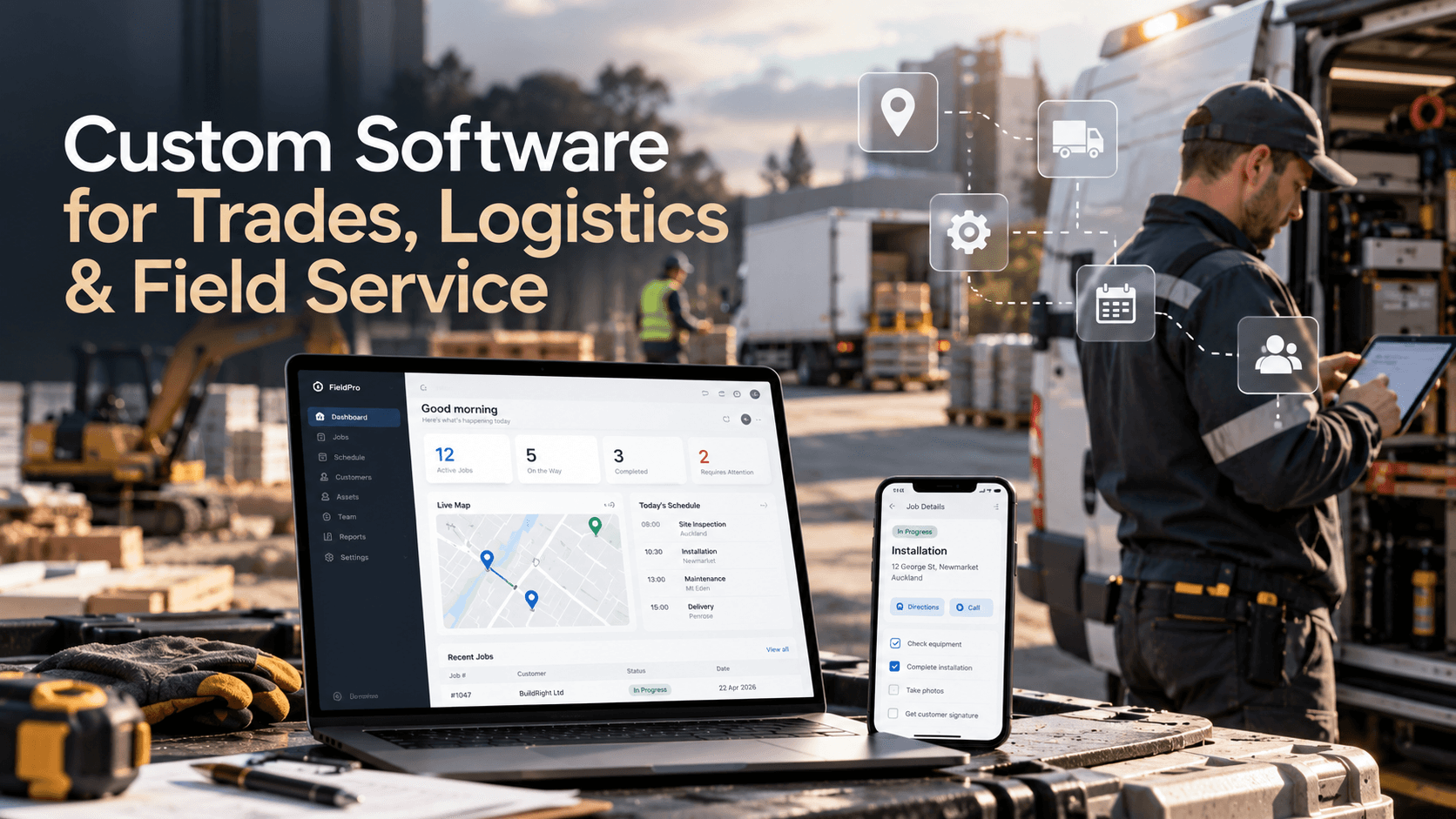
While most software headlines chase the next consumer app, the fastest-growing category in software right now is quietly running in the opposite direction: vertical SaaS, purpose-built software for a single industry, is growing at roughly 23.9% a year and is on pace to reach $157.4 billion by the end of 2026 — outpacing general-purpose horizontal tools by 2x. Almost none of that growth is happening in the industries that get funding-round headlines. It's happening in healthcare, logistics, construction, agriculture, and field service — the analog-heavy industries that were, for years, simply "too hard to digitize."
Why "boring" industries are where the money is
The reasoning is straightforward once you see it: these industries have real, expensive, recurring problems — revenue loss, labor shortages, compliance risk, operational bottlenecks — and almost no software built specifically to solve them. A generic project management tool doesn't understand what a plumbing dispatch actually needs. A generic CRM doesn't know what a fuel delivery audit trail has to prove. That gap is exactly where a small, focused team can build something a Fortune 500 company's internal tools team, or a big horizontal SaaS platform, never will: something narrow enough to be genuinely useful to the people actually doing the work.
$157.4B
vertical SaaS market by end of 2026
Growing at roughly 23.9% annually — outpacing horizontal (general-purpose) SaaS by 2x.
2x
faster growth than horizontal SaaS
Industry-specific tools are winning against one-size-fits-all platforms.
$9.5B
ServiceTitan's valuation
Built entirely for HVAC, plumbing, and electrical contractors — an industry Silicon Valley ignored for a decade.
The ServiceTitan story
ServiceTitan is the clearest proof this works at scale. Founders Ara Mahdessian and Vahe Kuzoyan grew up around their immigrant parents' small trades businesses and saw contractors still running on pen and paper while Silicon Valley poured money into consumer apps. Instead of building something easier to pitch, they built a tablet interface rugged and simple enough for a plumber with greasy hands — literally sitting in the back of service vans with technicians to get the product right. Today, ServiceTitan serves over 100,000 service professionals across 13,000 businesses, and reached a valuation around $9.5 billion. Nobody thought HVAC dispatch software was exciting. It was, it turns out, enormous.
We've done this before: FuelFlo
This is the exact pattern behind FuelFlo, a field-to-report system we built for temporary power and generator companies in Saudi Arabia — an industry with no obvious reason to have modern software, and enormous operational value in getting it right. Every fuel delivery gets turned into verified, timestamped, photo-backed evidence: GPS capture, offline-first sync so it works in the field with no signal, and client-ready reports generated in seconds instead of hours of manual paperwork. It's pilot-ready today, built the same way ServiceTitan was — by understanding the actual workflow of the people using it, not designing from a distance.
Why boutique studios fit this niche better than the alternatives
This is the exact spot where big agencies and no-code tools both fail founders in analog industries. A large agency is priced and staffed for enterprise engagements — a niche field-ops tool for a regional trades company is too small to be worth their overhead. No-code platforms, meanwhile, are built for generic workflows and hit a wall fast the moment your operation has a genuinely specific requirement — offline sync in a location with no signal, a compliance-driven audit trail, a device interface that has to survive a job site. A small, senior studio sits exactly in the gap: big enough to build something real and production-grade, small enough that a niche, unglamorous industry is worth its full attention.
If this is your industry
If you run a trades, logistics, construction, field service, or fitness-ops business and have gone looking for software built around how you actually work — dispatch, job costing, offline data capture at a site with no signal, compliance paperwork — and found nothing that fit, that search itself is the signal. It's rarely that your business is too niche to be worth building for. It's that nobody building software has looked closely enough at your workflow to build it well. Custom software for a logistics company, a construction business, or a field service operation isn't a bigger lift than any other product build — it just requires someone willing to understand the job before writing a line of code.
What building this looks like
A backend and database built for real operational data — offline sync, structured records, proper permissions — runs $2,000 over 2–4 weeks. A full product build, web and mobile and backend together, the way FuelFlo was built, starts from $8,500 over 8–14 weeks. If your industry has a workflow nobody's built software for yet, that's usually not a sign it's not worth building. It's usually a sign nobody's looked closely enough.
Sources
- 138 Vertical SaaS Categories for 2026 — DevSquad
- ServiceTitan: Business Breakdown & Founding Story — Contrary Research
Related services
Got a workflow nobody's built software for yet?
Book a short call and let's talk about what it would actually take to build it.