
Startups & MVPs
Building Your First MVP: What Actually Works

Nick
September 22, 2026 · 8 min read
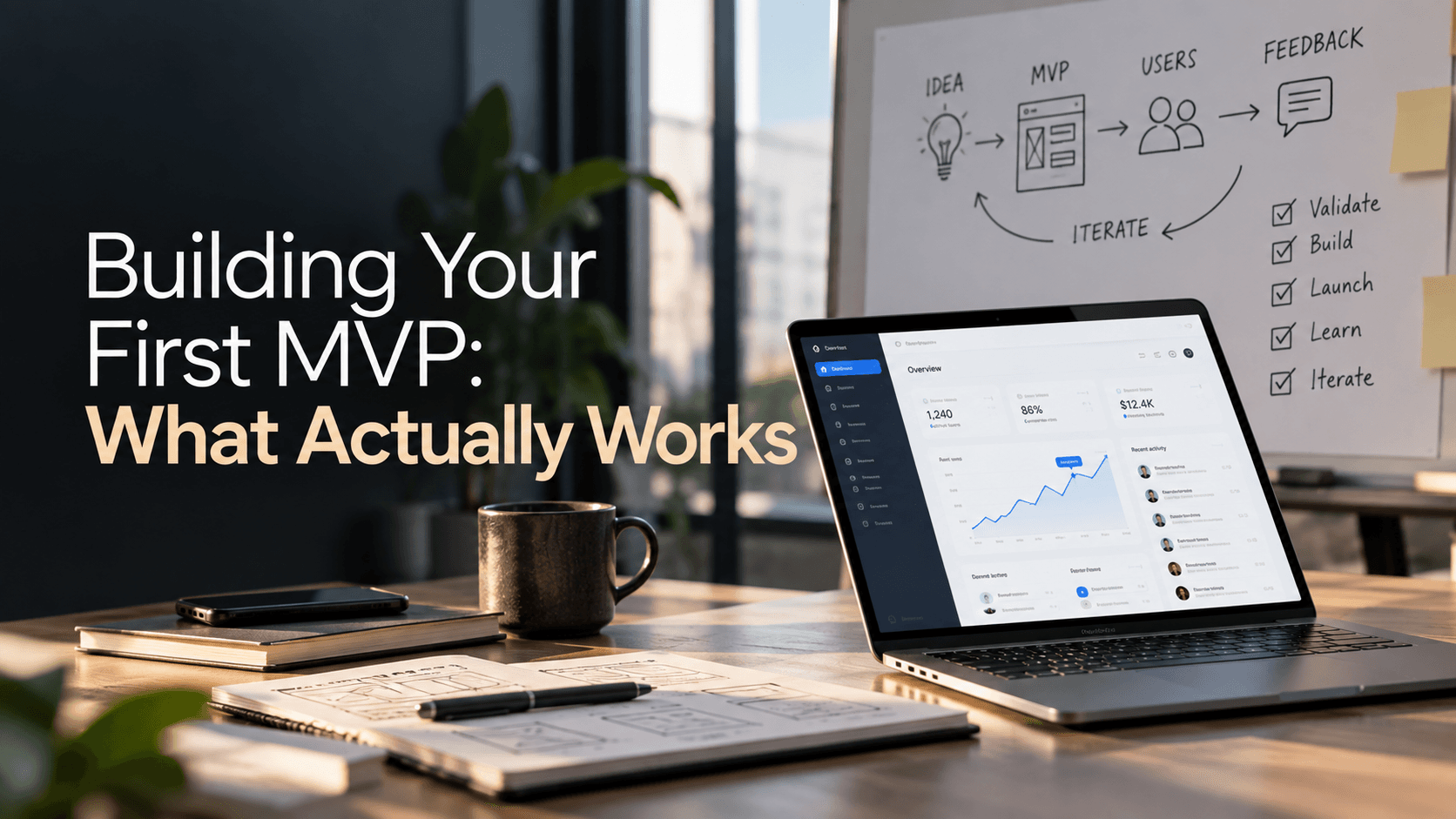
CB Insights has spent years collecting startup post-mortems, and one finding holds up year after year: poor product is cited as a cause of death in 17% of them — not "the market didn't want it," but the market wanted something like it and the thing that got built didn't hold up. For a pre-seed founder deciding how to build their first product, that's the number worth sitting with. The idea is rarely what kills you. The build is.
Two founders, two paths, same starting point
One story, documented in detail by the founder who lived it: a non-technical founder hired a freelance team through a marketplace to build a multi-tenant booking platform. The quote was $800, the promised delivery was 21 days. On day 22, the team delivered a zipped file and marked it done — a polished, responsive UI that looked, on the surface, like a finished product.
It wasn't. When the founder invited 15 local business owners into a beta, the cracks showed immediately: competitors could see each other's financial invoices just by changing a company ID number in the browser URL, because tenant isolation was never enforced on the backend — only assumed on the client. Payments ran client-side through Stripe, so a dropped connection after payment could charge a customer without ever notifying the backend, creating ghost transactions. The 14-table database had zero indexes, so with just 30 people testing the calendar, page loads crawled to 4.2 seconds. There wasn't a single automated test or a database migration script in the entire codebase.
$800
the original quote
For a multi-tenant SaaS booking platform, delivered in 22 days.
$6,000
to make it actually work
An 80-hour audit and stabilization pass — 7.5x the original price.
4,200ms → 38ms
page load, after fixing indexes
The database had zero indexes on a 14-table schema before the fix.
“An $800 quote for a full-stack SaaS is an uncollateralized loan with high interest that comes due during launch week.”
— From the founder's own account of the rebuild
The other path: what it looks like when it works
Contrast that with Fave, a fandom-community platform built with the product studio Altar.io. According to Altar.io's own case study, the studio worked through the product rationale alongside the engineering — including the call to launch on a cross-platform framework first, with a plan to move to fully native once the product proved itself, rather than over-building before anyone had used it. Fave went on to raise $4.2M, reach a $15M valuation, and grow past 50,000 users.
Or Plannin, a travel-planning platform whose MVP was built from scratch by the studio TeaCode. Post-launch, the product posted 70% month-over-month revenue growth — a number strong enough to bring in funding from an investor who happens to be Booking.com's former CEO. Neither of these was a bigger build than the $800 booking platform. They were the same size of problem, solved by a team with a process behind it instead of a quote optimized to win a bid.
Why the structure matters more than the price tag
The gap between those two outcomes isn't really about talent — solo freelancers can be excellent engineers. It's about what's missing when there's no team structure around the work: nobody reviews a solo freelancer's code before it ships, because there's no one else on the project. If they get sick, get busy with another client, or simply move on, the project stops, often with no documentation for whoever picks it up next. And most freelance contracts end the moment the code is "delivered" — there's no built-in window for the bugs that only show up once real users start clicking around, which is exactly when the booking-platform story fell apart. An agency or studio with any real process doesn't let code ship without a second set of eyes, keeps documentation as a matter of habit rather than an afterthought, and typically bakes 30–60 days of post-launch support into the engagement — because every MVP has issues in its first two weeks of real traffic, not its first two weeks of development.
What Y Combinator actually recommends
None of this is an argument for building more than you need. Y Combinator's own startup library is explicit on this point: an MVP is the smallest thing you can put in front of real users, and the temptation to build your complete vision instead of a stripped-down version is one of the more reliable ways to waste months on the wrong thing. The lesson from the stories above isn't "build bigger" — Fave's MVP deliberately shipped on a faster framework instead of a fully native app. It's "build the small thing properly." A minimal product with real tenant isolation, real tests, and a real migration path is still minimal. It's just not fragile.
What this actually costs, done right
Run the numbers on the cautionary story: $800 upfront, plus $6,000 to fix it, comes to $6,800 — and that's before counting the weeks the founder lost waiting for the rescue, or the trust burned with the 15 business owners who saw the leak firsthand. A properly scoped first build — backend and database done with real security and indexing from day one, a working dashboard or core UI, and QA before launch instead of after — is the kind of engagement we price as a Full Product Build, starting from $8,500 over 8–14 weeks, or scoped down to just the backend and data layer at $2,000 over 2–4 weeks if the front end is already underway elsewhere. The honest comparison isn't $800 versus $8,500. It's $6,800-and-a-security-incident versus doing it once.
If you're a pre-seed or seed founder trying to decide how to build your first real product, that's the actual question to ask any partner you're considering: not just what it costs, but who reviews the code, what happens when something breaks two weeks after launch, and whether tenant isolation and payment handling are things they'll mention before you have to ask.
Sources
- Why Startups Fail: Top Reasons — CB Insights
- How to Plan an MVP — Y Combinator Startup Library
- Fave Case Study — Altar.io
- Best MVP Development Agencies for Startups — TeaCode
- Why an $800 MVP Cost $6,000 to Make Work — DEV Community
Related services

Ready to build your first MVP the right way?
Book a free discovery call — we'll scope it with a fixed price and timeline before anything starts.